
A Brief History of the Mt Barker - Hahndorf Golf Club
145 Years of Adelaide Hills Golf Heritage
The story of Aston Hills Golf Club is actually the tale of two pioneering clubs whose histories interweave across nearly a century and a half, creating one of South Australia’s most enduring golf legacies. What began with a generous flour miller’s invitation to play among his prize gardens in 1879 has evolved into a modern golf destination that honors both its Mount Barker and Hahndorf heritage while serving the growing Adelaide Hills community.
The Dunn Legacy: Where it All Began
The remarkable journey begins in 1879 with John Dunn, a visionary businessman whose generosity would echo through generations of Adelaide Hills golfers. Having emigrated from Devon in 1840, Dunn had built South Australia’s second steam flour mill in Mount Barker by 1844, establishing his company as the largest milling business in the Southern Hemisphere. But it was his community spirit that truly defined his legacy.
At his magnificent property “The Laurels” – a 160-acre estate with impressive gardens built around 1857 – Dunn welcomed the region’s first golf enthusiasts to play among the established trees and gentle undulations. This informal beginning in 1879 makes Mount Barker Golf Club potentially the oldest golf club in South Australia, predating even the famous Royal Adelaide Golf Club by more than a decade.
John Dunn’s philanthropy extended far beyond golf. He served in both houses of the South Australian Parliament for nearly 20 years, funded the construction of the Dunn Memorial Church in 1884, built Salem Cottages for aged women and widows in 1879, and gifted Dunn Park to the community in 1892. When he died in 1894 at age 92, special trains brought mourners from Adelaide, shops closed, and flags flew at half-mast – a testament to the respect commanded by the man whose vision had given Adelaide Hills golf its start.
Three Clubs Born in One Remarkable Year
While Mount Barker golfers were enjoying their informal rounds at The Laurels, 1892 witnessed an extraordinary burst of golf enthusiasm across South Australia. Three clubs were founded in this single year: Adelaide Golf Club (later Royal Adelaide), Oakbank Golf Club, and Hahndorf Golf Club. This triumvirate represents the true foundation of organized golf in the colony, with Adelaide claiming the metropolitan crown while Hahndorf and Oakbank engaged in what remains “a photo-finish” for the title of oldest country club.
Hahndorf Golf Club’s early years were characterized by remarkable resilience. The club faced extraordinary challenges that would have defeated lesser organizations – courses that moved several times, playing conditions that included “fields ploughed for potatoes or paddocks used for grazing with greens fenced off to prevent straying dairy herds.” These agricultural hazards created a truly unique golfing experience where players navigated around farming operations and livestock – a far cry from today’s manicured fairways.
The club’s survival through these nomadic years demonstrated the extraordinary dedication of “prominent local golfing farmers” who lent land and support when needed. This agricultural integration wasn’t seen as a problem but became part of Hahndorf’s distinctive character, creating memorable moments that members would recall decades later.
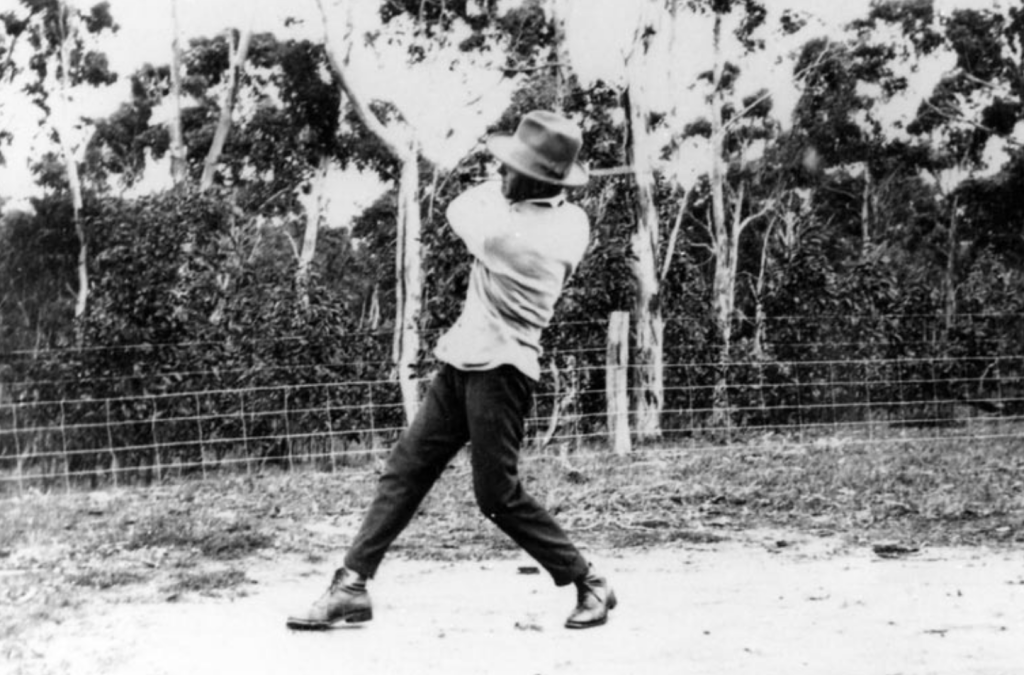
Mount Barker and Hahndorf, A Historic Partnership
History took a significant turn on April 12, 1907, when Mount Barker District Golf Club (officially recognized June 13, 1906) joined forces with Hahndorf Golf Club in their first amalgamation. This partnership lasted until 1912 and represented an important chapter in Adelaide Hills golf cooperation.
The highlight of this union came on September 28, 1907, with Mount Barker’s first recorded competitive match against McLaren Vale Golf Club, played on the links at Dunn’s Laurels property. Contemporary reports noted perfect weather conditions and visitors’ admiration for the excellent course condition. Mount Barker’s victory in this inaugural competitive match established a winning tradition that would endure through multiple relocations and reorganizations.
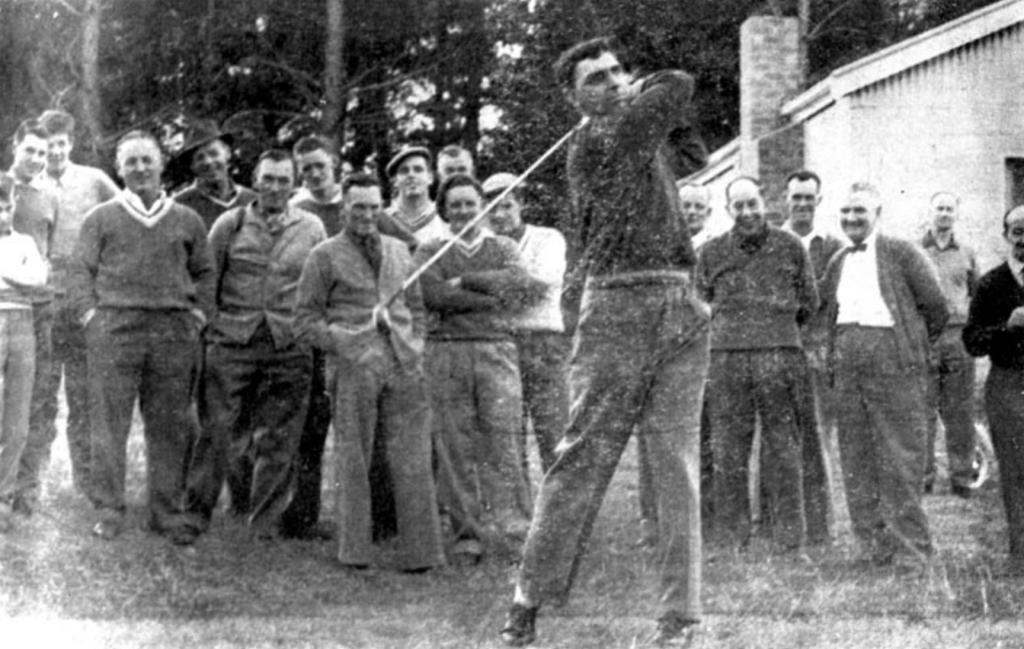
The Wardens and Forty-Five Years of Dedication
When the clubs separated in 1912, Mount Barker faced the challenge of finding a new home as The Laurels succumbed to development pressures. The solution came through another family’s generosity – the Wardens offered their property on Wellington Road, where the club would operate for the next 45 years until 1966.
Commander Warden became a legendary figure in the club’s history, and his personal putter – donated by his widow – remains displayed in today’s clubhouse as a tangible link to this era. Local residents recall the modest clubhouse “painted white with red battens” located in a paddock on Barker Road, where despite simple facilities, the club maintained its welcoming community spirit.
Meanwhile, Hahndorf Golf Club continued its own journey of relocations, supported by local farming families who understood the value of recreational facilities for their community. The club’s agricultural character provided natural challenges and scenic beauty that distinguished it from urban courses, creating a genuinely rural golf experience in the heart of the Adelaide Hills.
The Modern Transformation
The 1960s brought significant changes for both clubs. Mount Barker made the strategic decision to purchase 288 acres near Wistow in 1966, incorporating as a legal entity on April 6, 1966. The Wistow facility was built using almost entirely volunteer labor – a testament to member dedication that epitomized the community spirit sustaining both clubs.
Hahndorf Golf Club made its own crucial move in 1963, relocating to land owned by member Vic Nitschke. The Nitschke family, prominent German settlers in the Hahndorf area, provided the stability the club needed to flourish. This generous gesture literally saved the club and provided the foundation for its future success.
Both clubs achieved significant milestones in 1981 – Mount Barker moved from Wistow to its current location with better water access, while Hahndorf expanded from 9 to 18 holes on the Nitschke property. These developments positioned both clubs to capitalize on the golf boom that was beginning to sweep Australia.
Peak Membership and Prosperity
The 1980s and 1990s represented the golden age for both clubs, coinciding with Australia’s national golf boom. Mount Barker undertook major clubroom renovations in 1988, creating facilities that matched the course’s excellence. Both clubs achieved peak membership levels of 550-600 members from 1992 to 1996, reflecting the quality of their facilities and their reputation for hospitality.
1992 marked Hahndorf Golf Club’s centenary – an extraordinary achievement for any sporting organization, especially considering the club’s nomadic early years and various challenges overcome throughout its history. Reaching 100 years of continuous operation represented a remarkable milestone that few clubs achieve.
Mount Barker’s success during this period reflected not only facility quality but also the club’s reputation as a welcoming destination. The course, measuring 5,614 meters with a par 70 rating, offered gentle undulations, lush fairways, and excellent greens lined with majestic gum trees – characteristics that echoed its origins on Dunn’s pastoral property.
The Union of Mount Barker and Hahndorf Golf Clubs
By the early 2000s, changing demographics and financial pressures threatened both clubs’ sustainability. May 2004 brought a “significant and sad” Special General Meeting where Hahndorf Golf Club members decided to close the course and sell the property. This decision, while painful, created an opportunity for preserving both clubs’ legacies.
September 2007 marked the second amalgamation between Mount Barker and Hahndorf – a reunion that brought their histories full circle. At the Special General Meeting, members voted to form Mount Barker-Hahndorf Golf Club Incorporated, combining approximately 900 Mount Barker members with 600 Hahndorf members.
The merger was designed to “give both former clubs the chance to continue their long and illustrious histories together as a significant Hills golf club.” The injection of assets from Hahndorf’s property sale provided the merged club with financial security for years to come, while Mount Barker’s excellent facilities offered the perfect venue for the combined membership.
The Aston Hills Evolution
2017 brought another significant evolution when the club entered a partnership with the nearby Aston Hills housing development. The strategic decision to rebrand as Aston Hills Golf Club at Mount Barker provided significant annual payments and offered complimentary memberships to new home buyers, ensuring continued growth and community integration.
This partnership represents successful adaptation to modern community needs while preserving the club’s founding character. Under the leadership of Club Manager Brad Ashby and Club Professional Ben Traeger (2022 SA Club Professional of the Year), the club has enhanced its community focus while maintaining the welcoming atmosphere that has characterized it since John Dunn’s original invitation.
Honoring the Past, Embracing the Future
Today’s Aston Hills Golf Club stands as a living testament to the vision of John Dunn and the generations of volunteers who sustained it through 145 years of continuous operation. Commander Warden’s putter remains displayed in the clubhouse, connecting current members to the club’s rich heritage. The course itself embodies the natural beauty that first attracted early settlers, with native wildlife grazing among the fairways and majestic gum trees providing both challenge and scenic beauty.
The club’s commitment to junior development reflects its founders’ community-minded approach. Junior membership has become the fastest-growing category, with programs designed to introduce young people to both golf and the club’s remarkable history. The SA Sports Voucher Program makes junior membership accessible at just $50, continuing the tradition of community accessibility that began with John Dunn’s open invitation.
The Character That Endures
What distinguishes Aston Hills Golf Club today is the same spirit that enabled two historic clubs to survive, adapt, and ultimately thrive together. The course remains “the only Adelaide Hills golf course without any hills” – emphasizing accessibility over intimidation. The 180-degree panoramic views from the clubhouse showcase the Adelaide Hills beauty that inspired early settlers, while the well-maintained couch grass fairways and excellent greens provide the quality golf experience members expect.
The club’s reputation as “Adelaide Hills’ best-kept golfing secret” reflects not just the quality of facilities but the genuine warmth that welcomes both serious golfers and social players. Whether hosting its first pro-am tournament in over 30 years or providing a venue for community events, the club continues the tradition of community service that began with John Dunn’s generosity.
A Legacy of Resilience and Community
The story of Aston Hills Golf Club – encompassing the remarkable histories of both Mount Barker and Hahndorf golf clubs – represents more than just the evolution of a sporting facility. It embodies the pioneer spirit of early South Australia, the power of community cooperation, and the vision of individuals who understood that recreational facilities strengthen entire communities.
From John Dunn’s initial invitation to play among his prize gardens to Commander Warden’s family providing land for decades, from the Nitschke family’s generous support to the volunteer labor that built facilities, from the two successful amalgamations to the modern partnership with residential development – this is a story of ordinary people creating extraordinary legacies.
Today’s members inherit not just a golf course but a 145-year tradition of community spirit, resilience, and welcome. The club continues to serve the growing Adelaide Hills population while maintaining the character that made it special – a place where history lives alongside modern amenities, where newcomers become part of a story that began in the 19th century, and where the simple pleasure of golf continues to bring people together as it has for nearly a century and a half.
As Mount Barker continues to grow as one of South Australia’s fastest-developing regions, Aston Hills Golf Club at Mount Barker remains committed to its founding principles: providing excellent golf in a welcoming community environment, surrounded by the natural beauty of the Adelaide Hills that first attracted John Dunn and the pioneers who made this remarkable story possible.
The legacy continues, honoring the past while embracing the future, just as John Dunn would have envisioned when he first welcomed golfers to The Laurels all those years ago.